Endo belly
1. What is “endo belly”?
“Endo belly” is a term people with endometriosis and adenomyosis use to describe extreme and uncomfortable bloating.1 Their abdomen may become much larger over the course of a day or around certain times in the menstrual cycle. The bloating can come on seemingly without a trigger. Stress and heat are two common causes, but for many people, endo belly can occur without any known trigger, making it difficult to try to prevent. Endo belly is real, but isn’t fully understood.
2. What causes endo belly?
We don’t know exactly what causes endo belly. Inflammation, digestion, constipation, increased sensitivity in the gut, and changes in how the muscles work may all play a role. One possible cause is something called abdominophrenic dyssynergia, or APD.
APD happens when the diaphragm and abdominal muscles do not work together in their usual coordinated way.2,3 The diaphragm is the large breathing muscle underneath the lungs. Normally, the diaphragm and abdominal muscles adjust together to make room for food, fluid, and gas inside the abdomen. With APD, the diaphragm moves downward and the abdominal muscles relax outward. This pushes the contents of the abdomen forward, making the belly look and feel swollen (Figure 1).
This does not necessarily mean that there is an unusually large amount of gas or food inside the abdomen. The swelling may be partly caused by a change in how the muscles are holding and distributing what is already there.
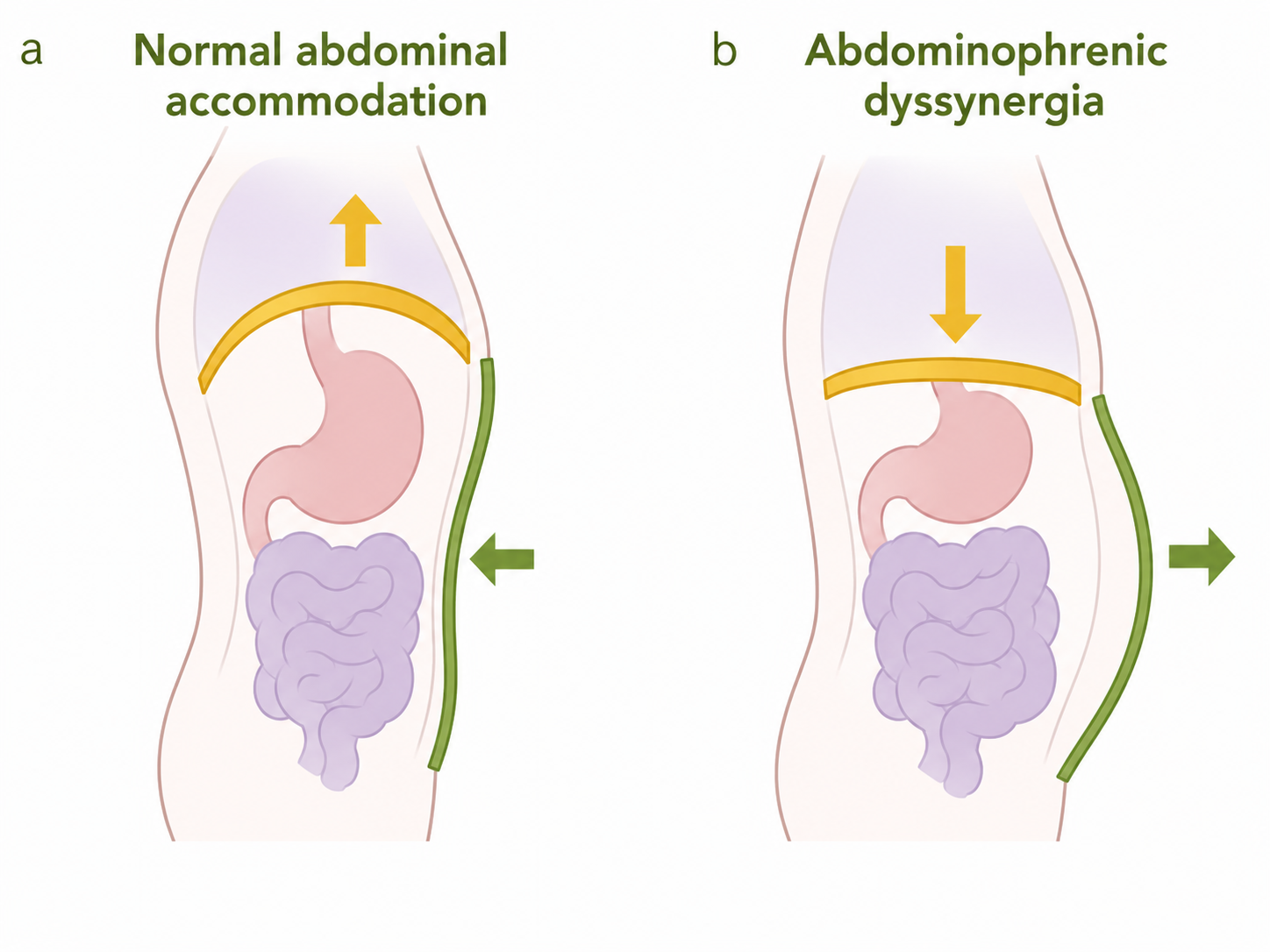
In normal accommodation, the diaphragm relaxes upward while the abdominal muscles contract to make room without visible bloating. In APD, the diaphragm contracts downward while the abdominal muscles relax outward, contributing to visible bloating.
3. Does surgery treat APD?
Endometriosis surgery may remove lesions, release adhesions, remove cysts, and reduce sources of pain and inflammation. However, surgery does not directly retrain the diaphragm and abdominal muscles to work together differently.
Years of pain, as well as adhesions, cysts, inflammation, and other physical changes, can affect the way a person stands, sits, sleeps, breathes, and exercises. People may begin holding their breath, tightening certain muscles, protecting one side of the body, or changing their posture to avoid pain.
Over time, these protective patterns can become automatic. They may continue even after the original source of pain has been treated. Surgery may therefore remove some of the factors contributing to the problem without automatically correcting an ingrained muscle pattern.
4. Is there research on APD?
There is research on APD in people with digestive conditions, including irritable bowel syndrome (IBS) and other disorders involving bloating and abdominal distension. So far, APD has not been directly studied in people with endometriosis. We can’t assume that all endo belly is caused by APD, or that APD works exactly the same way in endometriosis and IBS. However, endometriosis and IBS may share some contributing factors, including chronic pain, increased sensitivity between the gut and brain, digestive symptoms, and changes in how the abdominal muscles respond. APD may explain at least part of the visible abdominal swelling experienced by some people with endometriosis. Women with endometriosis are 3x more likely to have IBS than women without, so there may be other connections between the two disorders we don’t understand yet.4
5. What treatments are available for APD?
Because APD has not been specifically studied in people with endometriosis, there is currently no proven APD treatment designed specifically for endo belly.
Research in people with digestive disorders like IBS suggests that biofeedback may help. Biofeedback uses sensors or other forms of feedback to help a person see how their breathing and abdominal muscles are working. They can then practice changing the pattern so that the diaphragm and abdominal wall work together more normally. Although specific research hasn’t been done for endo belly, there have been multiple research studies that were successful in treating bloating in IBS patients by using biofeedback in a research lab setting.5–7 Biofeedback devices that target muscles involved in bloating are not currently available for at-home use.
Given the similarity of the issues, working on breath, diaphragm movement, and coordination of the abdominal muscles may play a significant role in improving endo belly. Physical therapy can help address breathing, posture, rib movement, abdominal coordination, pelvic floor function, and protective muscle patterns. Hands-on treatments, such as massage or other forms of manual therapy, may help with pain, stiffness, or body awareness for some people. However, physical therapy and massage have not yet been directly tested as treatments for APD associated with endometriosis. They should be described as possible supportive approaches and not established cures.
Most importantly, endo belly is not a personal failure, a lack of fitness, or something a person is doing on purpose. It may involve an automatic response that the nervous system and muscles have learned over time. With the right support, some of these patterns may be retrained.
Takeaway:
Although specific research hasn’t been done for endo belly, there have been multiple research studies that were successful in treating bloating in IBS patients by retraining the muscles in the abdomen. Given the similarity of the issues, working on breath, diaphragm movement, and coordination of the abdominal muscles may play a significant role in improving endo belly. More research is needed.
References
- Velho RV, Werner F, Mechsner S. Endo Belly: What Is It and Why Does It Happen?—A Narrative Review. J Clin Med. 2023;12(22):7176. doi:10.3390/jcm12227176
- Zadeh RGB, Roghani T, Gladin A, Katzman WB, Bokaee F, Adibi P. Spinal-Related Musculoskeletal Determinants of Functional Abdominal Bloating and Distension: A Narrative Review. Health Sci Rep. 2025;8(7):e70976. doi:10.1002/hsr2.70976
- Damianos JA, Tomar SK, Azpiroz F, Barba E. Abdominophrenic Dyssynergia: A Narrative Review. Am J Gastroenterol. 2023;118(1):41-45. doi:10.14309/ajg.0000000000002044
- Nabi MY, Nauhria S, Reel M, et al. Endometriosis and irritable bowel syndrome: A systematic review and meta-analyses. Front Med. 2022;9. doi:10.3389/fmed.2022.914356
- Barba E, Burri E, Accarino A, et al. Abdominothoracic mechanisms of functional abdominal distension and correction by biofeedback. Gastroenterology. 2015;148(4):732-739. doi:10.1053/j.gastro.2014.12.006
- Barba E, Accarino A, Azpiroz F. Correction of Abdominal Distention by Biofeedback-Guided Control of Abdominothoracic Muscular Activity in a Randomized, Placebo-Controlled Trial. Clin Gastroenterol Hepatol Off Clin Pract J Am Gastroenterol Assoc. 2017;15(12):1922-1929. doi:10.1016/j.cgh.2017.06.052
- Barba E, Livovsky DM, Accarino A, Azpiroz F. Thoracoabdominal Wall Motion–Guided Biofeedback Treatment of Abdominal Distention: A Randomized Placebo-Controlled Trial. Gastroenterology. 2024;167(3):538-546.e1. doi:10.1053/j.gastro.2024.03.005
Last updated: August 2026